Vague code reviews end here.
Defect Marker adds one-click #Severity:Type labels to every GitHub PR comment. Reviews become searchable, severity becomes obvious, and nothing slips through.
- Zero permissions
- No account
- 100% local
Reviews without structure don't scale.
Unlabeled comments can't be searched, sorted, or audited. Six months later, nobody knows what was a blocker and what was a nitpick.
“this looks wrong”
No severity. No category. No follow-up.
“nit: clean this up later”
“Later” never comes.
“??”
Fifteen replies to figure out what it meant.
- #Major:Missing
Auth header never validated — reject with 401.
- #Minor:Inconsistent
camelCase everywhere else in this file.
- #Cosmetic:Improvement
One-liner with Array.from.
Everything reviewers need, nothing they don't.
Defect Marker stays out of the way until you need it — then it makes labeling a single, deliberate action.
Smart detection
Finds every comment editor across PR conversations, reviews, replies, and inline diffs — layered discovery survives GitHub's soft navigation and lazy rendering.
One-click pills
No dropdowns. Every Severity and Defect Type is visible at a glance and selected with a single click or the arrow keys. The label is inserted for you.
Submission guard
Submit buttons stay disabled while a defect classification is incomplete or its label was deleted — labels never get lost in long review threads.
Native theming
The panel reads GitHub's own Primer CSS variables, so it matches light, dark, dimmed, and high-contrast themes automatically.
Severity at a glance
Color-coded Major / Minor / Cosmetic tints flow through the pills, the preview chip, and the panel border — triage is obvious for the next reviewer.
Accessible by default
Real form controls, visible focus rings, aria-live validation messages, and full prefers-reduced-motion support.
From open PR to labeled defect in seconds.
Four steps. No configuration. Compatible with every GitHub UI variation we've seen.
Open a pull request
Defect Marker activates automatically in any GitHub PR comment editor — legacy UI or the new React-based one.
Mark as defect
A compact panel sits between the editor and its footer. Tick the checkbox and the pill groups animate open.
Pick severity & type
One click each: Major, Minor, or Cosmetic, then Missing, Extra, Risk-prone, and more. The label is prepended for you.
Submit with confidence
Submit stays disabled until the label is valid and present. Your team gets searchable, consistent feedback.
The real thing, inside a real PR.
Actual screenshots from a GitHub pull request — the panel waits quietly under the comment box, then expands into one-click pills.
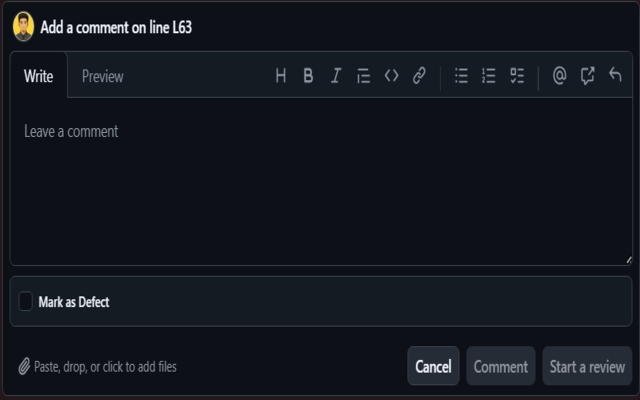
A quiet checkbox under every comment box
Open any inline comment on a PR and 'Mark as Defect' is already there — no popups, no setup. Leave it unticked and GitHub behaves exactly as normal.
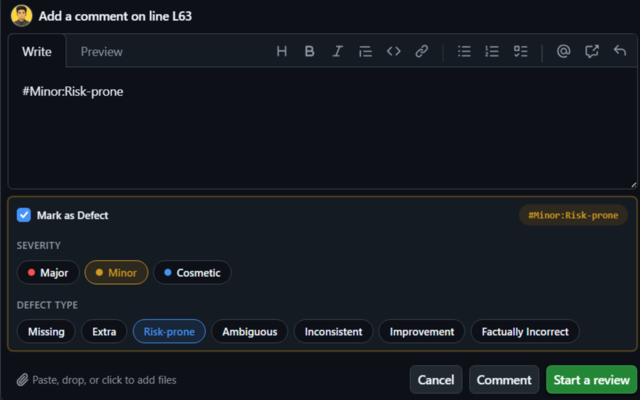
Tick it, click two pills, done
Severity and Defect Type expand as color-coded pills. Picking Minor + Risk-prone prepends #Minor:Risk-prone to the comment and shows it in the live preview chip.
Three severities. Seven types. One source of truth.
Every defect comment gets a structured #Severity:Type tag — searchable, sortable, and instantly recognizable.
Must be fixed before approval.
Should be fixed, but not a blocker.
Style and polish level issues.
> #Major:Missing This endpoint never validates the auth header — request
should reject with 401 before touching the database.

> #Minor:Inconsistent We're using camelCase elsewhere in this file.

> #Cosmetic:Improvement Could be a one-liner with Array.from.
Answers, before you ask.
Still curious? Open an issue on the repo and we'll get back to you.
Yes. Defect Marker detects both the legacy form-based UI and the redesigned React-based comment editor, writing labels through React-safe text insertion so both UIs honor them.
No. Everything runs locally in your browser. The extension requests zero Chrome permissions — no background worker, no network requests, no storage, no telemetry.
No. The panel is styled entirely with GitHub's own Primer CSS variables, so it follows light, dark, dark-dimmed, and high-contrast themes automatically.
No. Labels are only enforced when you explicitly tick 'Mark as Defect'. Regular comments work exactly as before, and the extension only re-enables buttons it disabled itself.
The defaults match common review conventions (Major / Minor / Cosmetic and seven defect types). Custom presets are on the roadmap.
Install in under 30 seconds.
Add Defect Marker to Chrome and your next review comment ships with a label your whole team can search.